Blog
What to Do When You Feel Overwhelmed by Your Habits

Neuroscientist · attention, motivation & behavior research
Turn overwhelm into one trackable next step with a calmer habit reset loop inside SelfSpark.
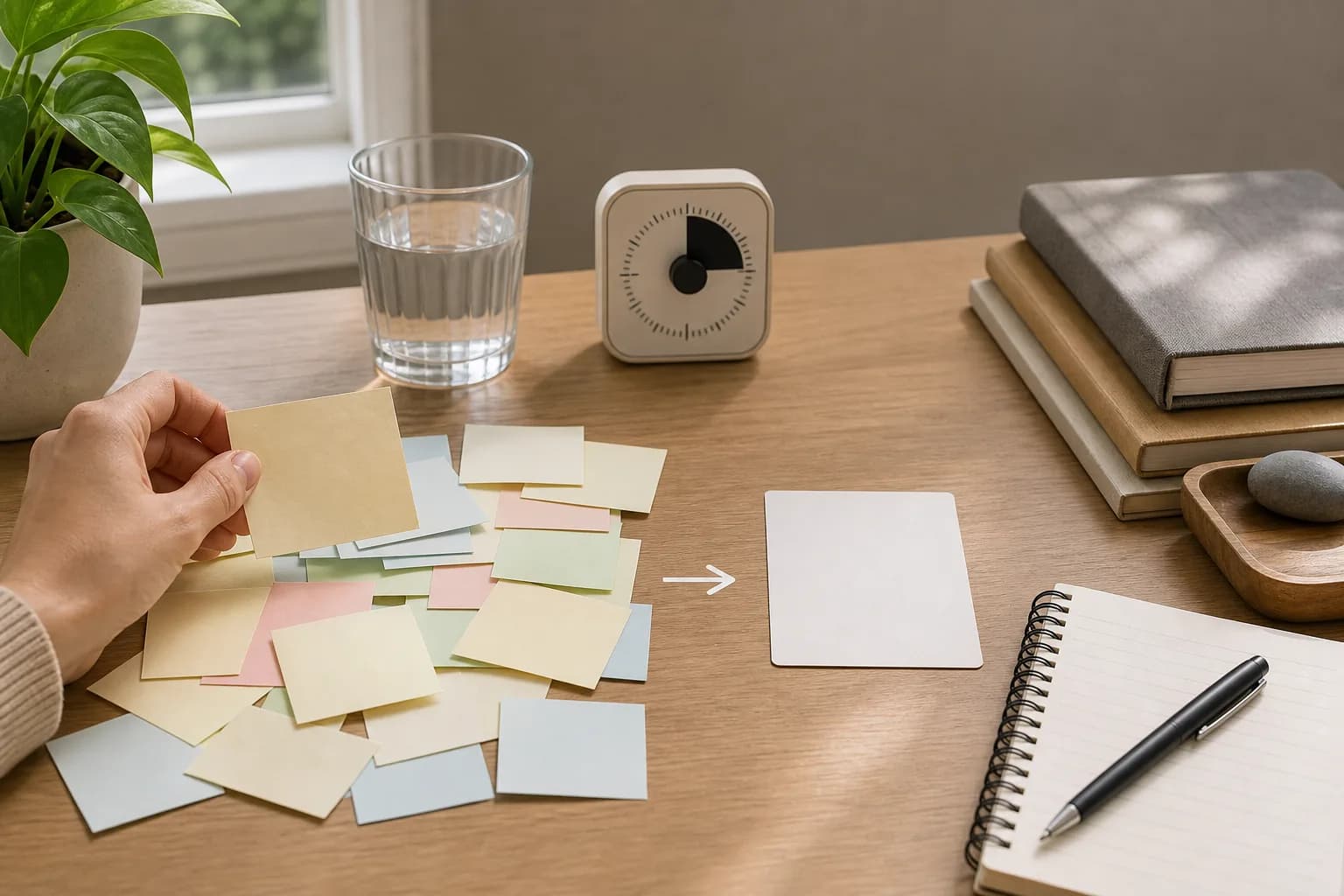
Overwhelm makes every habit look urgent at the same time. You are not just choosing a workout, a journal entry, or a planning session. You are choosing between ten open loops, and your brain understandably wants to close the laptop instead.
For overwhelm, the lighter SelfSpark approach is to protect one clean return point. Lower one habit, move the rest out of today's decision space, and keep a note about what made the plan feel crowded.
The pattern to notice
- Your list grows faster than your available energy.
- You keep reorganizing the plan instead of doing one action.
- A missed day turns into “I am behind on everything.”
If this sounds familiar, the goal is not to become a different person by Monday. The goal is to make the next return easier than the last one. For the full framework, read what makes a habit tracker recovery-friendly; if the pressure comes from unrealistic scheduling, see poor time management and smaller habit loops.
Try it in SelfSpark
Use SelfSpark as a pressure release valve. Pick one habit, lower the target, and write a short note about what made today heavy. The win is not catching up. The win is creating one clean return point.
Open SelfSpark and try this tiny loop:
- Choose one habit only.
- Set the smallest honest version for today.
- Move everything else into “not now” instead of “failed.”
- Use Journal to name the pressure in one sentence.
That is enough for today. If the action grows naturally, great. If it does not, you still trained the return.
Make the habit recovery-friendly
A recovery-friendly habit has a normal version and a low-energy version. The low-energy version is not a consolation prize; it is the bridge that keeps the habit alive when the day is messy.
Use this rule inside SelfSpark: if the habit feels too big to start, shrink it until you can do it without bargaining. Then track that version. Momentum counts even when it is small.
For a guided starting point, take the SelfSpark habit fit quiz and turn today’s pattern into one small recovery-friendly action.
FAQ
What should I do first?
When you are overwhelmed, do not rebuild your whole routine. Choose one recovery action. SelfSpark is useful because it lets you preserve momentum without pretending your capacity is unlimited.
Should I mark a small version as a real completion?
Yes. If it was the planned recovery version, it counts. The point is to keep the habit connected to real life, not to protect an unrealistic streak.
How does SelfSpark help?
SelfSpark combines habit tracking with short reflection, so you can see what happened, adjust the next step, and return without turning one missed day into a full restart.
How to turn this guide into a habit plan
Read the article once for the idea, then choose one action small enough to do on a busy day. SelfSpark works best when a habit has a full version, a reduced version, and a recovery version. The full version is what you do on a normal day. The reduced version is the smallest useful action when energy is low. The recovery version is what gets you moving again after a missed day without treating the miss as failure.
If this article compares tools, use it to decide what support you need before you pick an app. If it explains a template or habit method, write down the exact trigger, the minimum action, and how you will restart after an interruption. A good habit system should make the next step obvious when you are tired, distracted, traveling, or already behind.
SelfSpark is designed around that kind of recovery-friendly tracking. The quiz helps you choose a first plan, the tracker keeps progress visible, and short journal notes help you learn why a habit slipped so the next plan can adapt instead of becoming another rigid streak.
For the next seven days, treat the habit as an experiment. Keep the target small, write down what made it easier or harder, and adjust the plan based on what actually happened. That feedback loop is usually more useful than a perfect schedule you only follow once.