Guides
What Is a Habit Tracker? (And How They Actually Work)

Founder of SelfSpark · 15 years exploring self-help & personal growth
A habit tracker is a simple tool for marking off habits each day so progress stays visible. Here's what a habit tracker is, how it works, and whether you need one.
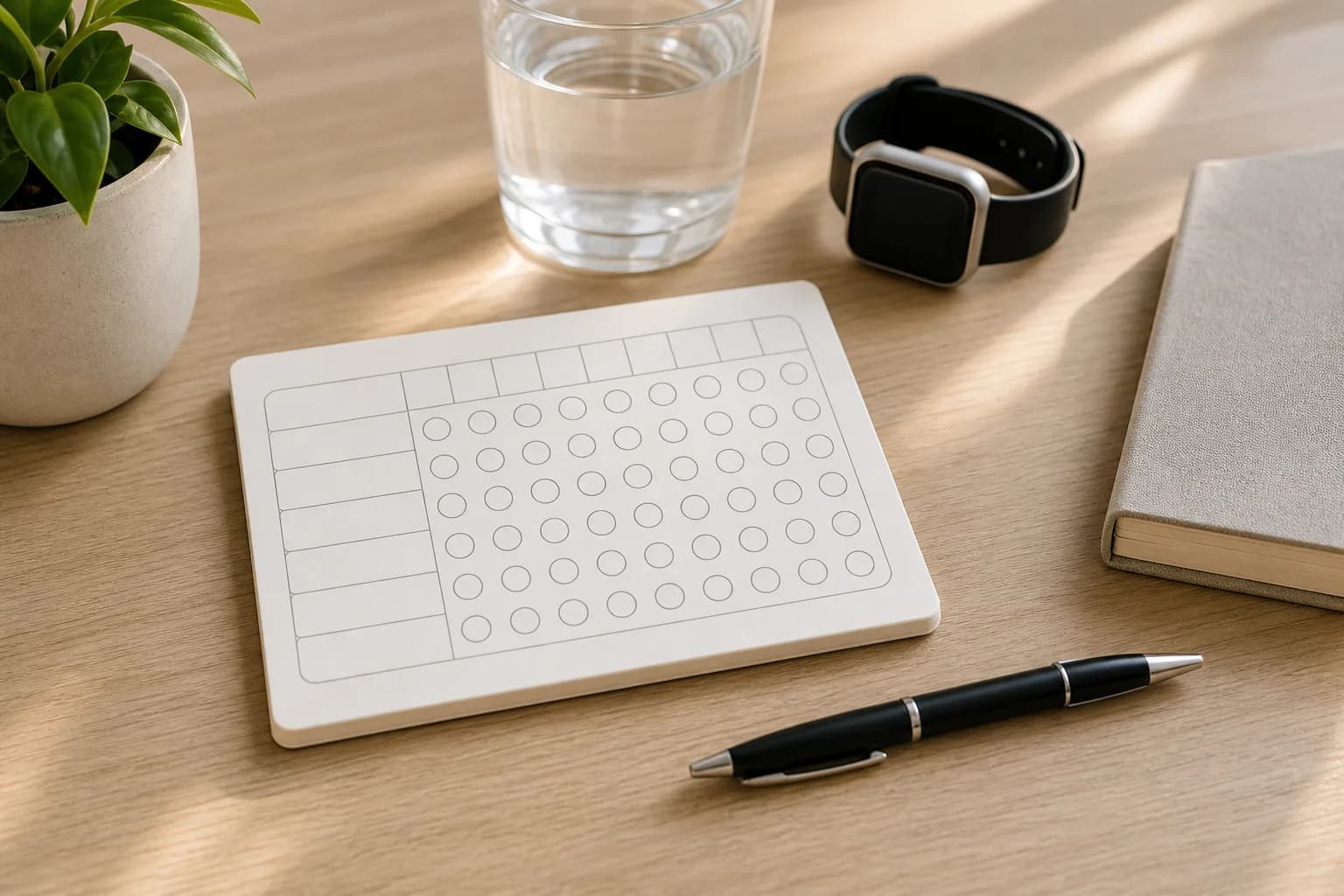
I am very good at starting things and, historically, terrible at week three. Running, flossing, the meditation app I downloaded twice — all of them died quietly somewhere around day eighteen, usually after one missed day that turned into "well, I've ruined it now." I never wrote anything down. So I never actually saw the pattern. I just felt like a person who couldn't stick to things.
A habit tracker is the small, almost embarrassingly simple fix for that. It's a tool — paper, spreadsheet, or app — where you mark whether you did a habit each day. That's it. You take an invisible behaviour and turn it into a visible mark, and the mark does a surprising amount of work: it reminds you, it rewards you, and it shows you the truth instead of the feeling.
How does a habit tracker work?
A habit tracker really only does three things. The power is that it does them every single day, so you don't have to.
- It makes the habit obvious. Seeing the tracker reminds you the habit exists. Out of sight is, reliably, out of mind — that was my whole problem.
- It records the action. You tick a box, fill a square, or tap a button the moment you finish.
- It shows progress. A row of marks is plain visual proof you're moving, and proof is more honest than mood.
That last point isn't just a nice feeling. Harvard's Teresa Amabile and Steven Kramer described the progress principle: of all the things that lift motivation, the single biggest is simply seeing that you made progress, however small. A tracker is a machine for manufacturing that "I moved forward today" signal on demand.
So you're not leaning on memory or motivation — both of which lie to you. The tracker carries the structure.
What can you track?
Almost any repeatable behaviour: drinking water, walking, reading, a fixed bedtime, meditation, taking medication, journaling, budgeting. The best ones to track are small, specific, and tied to something you actually care about. (Vague ones like "be healthier" can't be ticked, so they don't work.) For a proper list, see habits to track, and for layout ideas, habit tracker ideas.
What are the types of habit trackers?
- Paper / printable — fast, frictionless, and oddly satisfying. Start with the free printable habit tracker or a bullet journal layout.
- Spreadsheet — customisable, automatic, slightly nerdy (I mean that as a compliment). See the Google Sheets or Excel templates.
- Notion / digital docs — habits living next to your notes. See the Notion habit tracker guide.
- Apps — reminders, stats, and sync across devices, like SelfSpark.
There's no "best" one in the abstract. The best tracker is the one you'll actually look at tomorrow.
Do habit trackers actually work?
For most people, yes — but I want to be honest about the one place they fail, because it's the place they failed me.
Trackers are excellent at building momentum and genuinely bad at handling disruption. The same streak that motivates you on day 20 turns into a weapon on day 21 when you miss. "I broke it, so why bother" is, in my experience and in plenty of others', the single most common reason people quit — not laziness, but a perfect run that finally cracked.
And here's the part the streak-obsessed culture gets wrong: there is no magic finish line. The famous "21 days to a habit" line is a myth. When Phillippa Lally's team at University College London actually measured it (published in 2009), habits took a median of 66 days to become automatic — and individuals ranged from 18 days to 254. Which means the messy middle is long, and a missed day inside a 66-day stretch is not failure. It's just Tuesday.
So a good habit tracker shouldn't only celebrate perfect rows. It should have a recovery plan: a way to do a smaller version on a hard day and keep your progress visible after you slip. That's the whole idea behind SelfSpark — it's an adaptive tracker that suggests a smaller next step on low-energy days and treats a miss as a re-entry point, not a verdict. More on that in our recovery-friendly habit tracker guide.
How to get started
- Pick one or two habits. Not ten. I know you want ten.
- Choose a format you'll physically see every day.
- Make each habit small enough to do on a bad day, not just a good one.
- Mark it daily, review it weekly.
That's the floor. Ready? Take the 2-minute habit fit quiz to find a setup that fits your real week, or read how to use a habit tracker next.
FAQ
What is a habit tracker in simple terms?
It's a tool where you mark off a habit each day so you can see whether you're actually doing it. The visible record makes the habit easier to remember and more rewarding to repeat — it replaces "I feel like I've been slacking" with the actual facts.
How does a habit tracker help build habits?
It creates a feedback loop: the tracker reminds you of the habit, you record the action, and the visible progress rewards you. That loop does the job willpower keeps failing to do.
Do habit trackers really work?
They work well for building momentum but can backfire when one missed day makes you feel you've "ruined" a streak. Trackers that let you do a smaller version after a miss — and keep the progress visible — are far more sustainable.
What's the best type of habit tracker?
The best one is the format you'll keep looking at daily — paper for simplicity, a spreadsheet for control, or an app for reminders and recovery features. Start simple; upgrade only if you actually hit the limits.
Sources
- Teresa M. Amabile and Steven J. Kramer, "The Power of Small Wins," Harvard Business Review, 2011. HBR article.
- Phillippa Lally, Cornelia H. M. van Jaarsveld, Henry W. W. Potts, and Jane Wardle, "How are habits formed: Modelling habit formation in the real world," European Journal of Social Psychology, 2010. Wiley DOI page and UCL summary.
- Benjamin Gardner, Phillippa Lally, and Jane Wardle, "Making health habitual: the psychology of 'habit-formation' and general practice," British Journal of General Practice, 2012. Full text at PMC.
Bottom line
A habit tracker turns invisible behaviour into a visible record, so habits get easier to build and harder to silently abandon — the way mine used to. Pick a format you'll see daily, keep the habits small, and choose one that helps you recover after a miss instead of punishing you for it. Try SelfSpark to do exactly that.
How to turn this guide into a habit plan
Read the article once for the idea, then choose one action small enough to do on a busy day. SelfSpark works best when a habit has a full version, a reduced version, and a recovery version. The full version is what you do on a normal day. The reduced version is the smallest useful action when energy is low. The recovery version is what gets you moving again after a missed day without treating the miss as failure.
If this article compares tools, use it to decide what support you need before you pick an app. If it explains a template or habit method, write down the exact trigger, the minimum action, and how you will restart after an interruption. A good habit system should make the next step obvious when you are tired, distracted, traveling, or already behind.
SelfSpark is designed around that kind of recovery-friendly tracking. The quiz helps you choose a first plan, the tracker keeps progress visible, and short journal notes help you learn why a habit slipped so the next plan can adapt instead of becoming another rigid streak.
For the next seven days, treat the habit as an experiment. Keep the target small, write down what made it easier or harder, and adjust the plan based on what actually happened. That feedback loop is usually more useful than a perfect schedule you only follow once.