Templates
Habit Tracker Calendar — Free Printable Calendar-Style Tracker

Product and habit systems research
A habit tracker calendar lets you mark habits on a familiar monthly calendar grid. Get a free printable, plus digital calendar tracking options and how to use them.
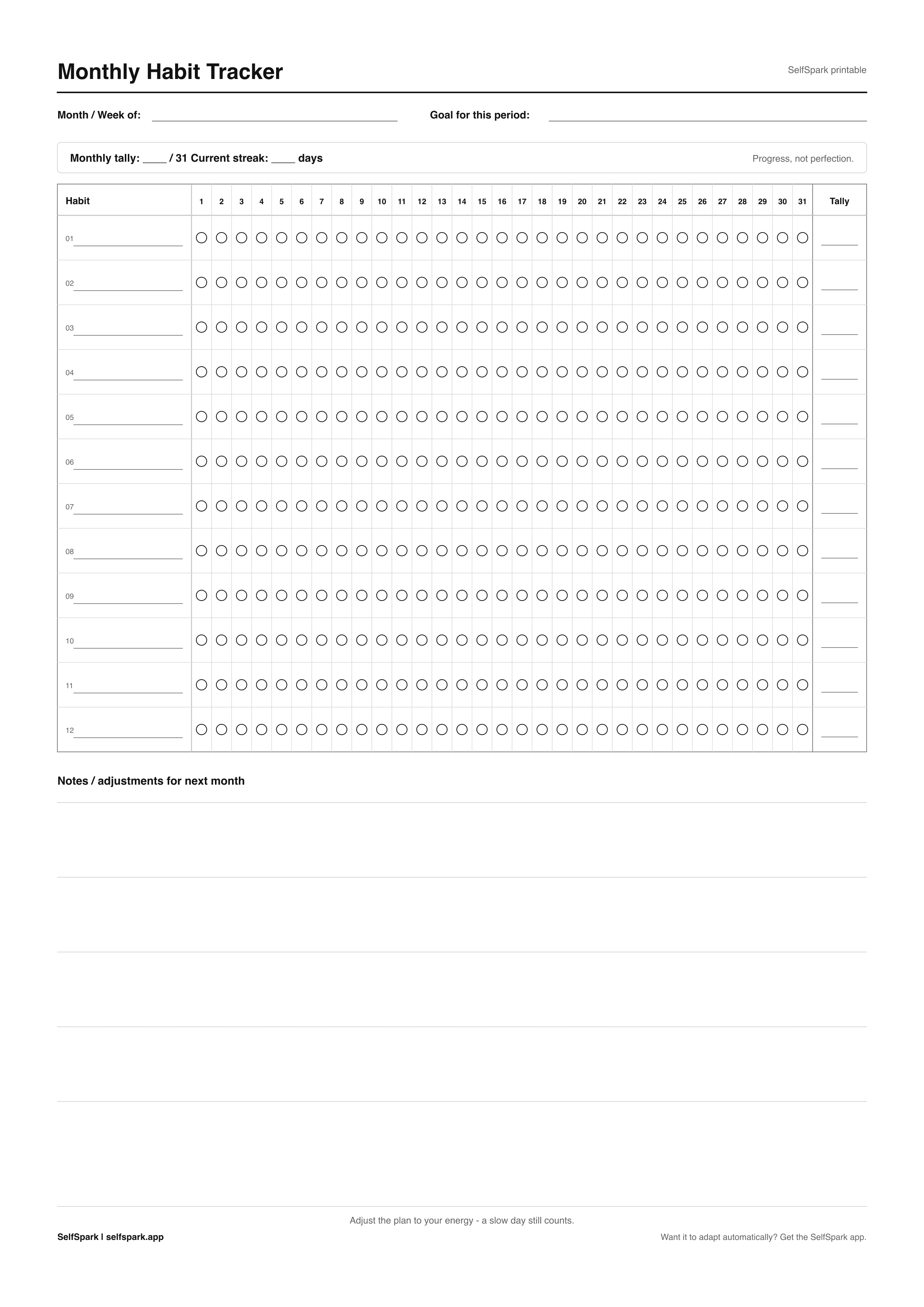
A habit tracker calendar is a monthly calendar grid where you mark each day you complete a habit, so your progress maps onto the same familiar layout you already use to plan your life. It's intuitive, visual, and great for "don't break the chain" tracking. Download a free printable below or track habits on a digital calendar.
Download the printable calendar tracker (PDF)
The monthly habit tracker layouts work perfectly as a calendar-style tracker — a full month on one page:
See every layout (daily, weekly, monthly, complete) on the printable habit tracker page.
Why use a calendar to track habits?
- Familiar layout — you already think in calendar weeks and months.
- "Don't break the chain" — a visible run of marked days motivates you to keep it going.
- Context — you can see habits next to the events and busy days that affect them.
- Single habit focus — colour one habit across the month to build a streak.
How to use a habit tracker calendar
- Choose one or a few habits to mark on the calendar.
- Mark each day you complete the habit — a colour, an X, or a sticker.
- Aim not to break the chain. The unbroken run becomes its own motivation.
- Review the month to see which days and weeks tripped you up.
For what to track, see habits to track; for more layouts, see habit tracker ideas.
Digital calendar tracking
You can also track habits on a digital calendar by adding a recurring event or using a Google Sheets or Notion calendar view. These add automatic totals and reminders.
When the chain breaks
The "don't break the chain" method is powerful — until the chain breaks. A single gap on a calendar can feel like failure and trigger the all-or-nothing quit. A paper calendar can't help you restart.
SelfSpark is an adaptive habit tracker that treats a broken chain as a re-entry point: it suggests a smaller version of the habit, keeps your progress visible, and helps you start a new chain without shame. Take the habit fit quiz.
FAQ
What is a habit tracker calendar?
It's a monthly calendar grid where you mark each day you complete a habit, mapping your progress onto a familiar calendar layout — ideal for "don't break the chain" tracking.
Is the printable habit tracker calendar free?
Yes. The monthly calendar-style PDFs above are free to download and print in A4 and US Letter, in colour or black & white.
How do I use the "don't break the chain" method?
Mark every day you do the habit on the calendar and try to keep the run of marked days unbroken. The growing chain motivates you to continue.
What happens when I break the chain?
Don't treat it as failure. Start a new chain the next day, ideally with a smaller version of the habit. Apps like SelfSpark make this restart easy by keeping your overall progress visible.
Bottom line
A habit tracker calendar maps your progress onto a familiar monthly grid and motivates an unbroken chain. Download the free printable, and for help restarting when the chain breaks, try SelfSpark.
How to turn this guide into a habit plan
Read the article once for the idea, then choose one action small enough to do on a busy day. SelfSpark works best when a habit has a full version, a reduced version, and a recovery version. The full version is what you do on a normal day. The reduced version is the smallest useful action when energy is low. The recovery version is what gets you moving again after a missed day without treating the miss as failure.
If this article compares tools, use it to decide what support you need before you pick an app. If it explains a template or habit method, write down the exact trigger, the minimum action, and how you will restart after an interruption. A good habit system should make the next step obvious when you are tired, distracted, traveling, or already behind.
SelfSpark is designed around that kind of recovery-friendly tracking. The quiz helps you choose a first plan, the tracker keeps progress visible, and short journal notes help you learn why a habit slipped so the next plan can adapt instead of becoming another rigid streak.
For the next seven days, treat the habit as an experiment. Keep the target small, write down what made it easier or harder, and adjust the plan based on what actually happened. That feedback loop is usually more useful than a perfect schedule you only follow once.